
Your CDL skills test is designed to confirm that you can safely inspect, control, and operate a commercial vehicle under real testing conditions. The examiner is not looking for speed — they are looking for safe habits, correct procedures, and consistent control. The test is completed in three parts, and they must be taken in order: Vehicle Inspection, Basic Vehicle Control, and On-Road Driving. You must test in the same type of vehicle you are seeking to be licensed to operate.
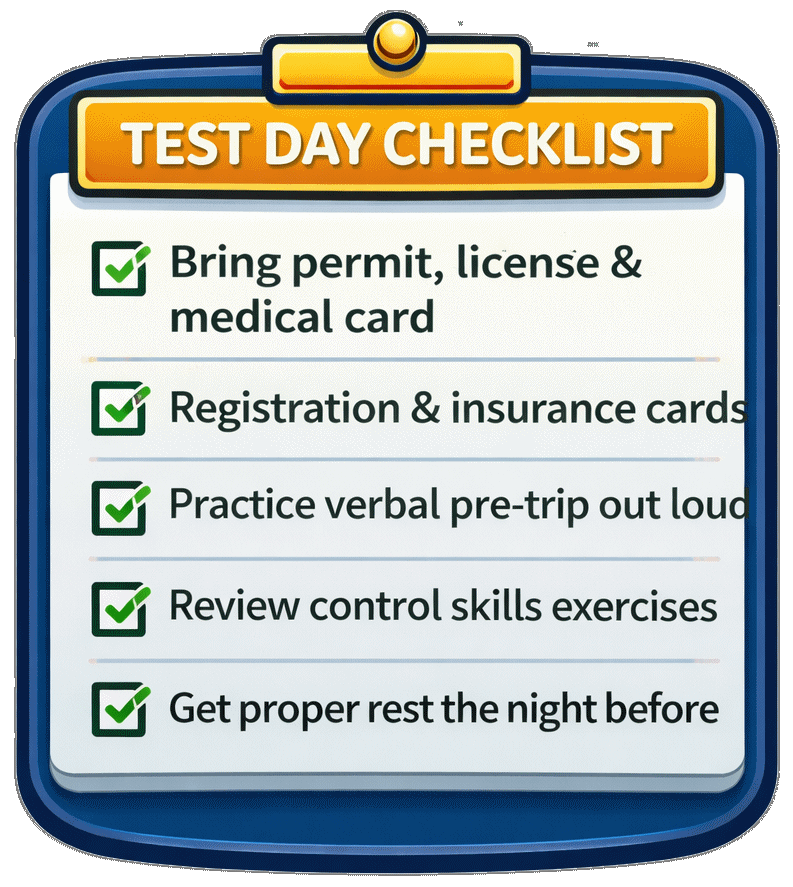
The first part is the Vehicle Inspection test. You will be asked to perform a structured inspection and explain to the examiner what you are checking and why it matters for safety. This includes exterior, interior, and engine compartment items, and for air-brake vehicles, required brake checks. This portion is verbal and procedural — you are demonstrating knowledge and safety awareness, not just pointing at parts.
Next is the Basic Vehicle Control Skills test. This takes place in a controlled area using boundary lines, cones, or lane markings. You will be asked to perform specific low-speed maneuvers such as forward stop, straight-line backing, forward offset tracking, and reverse offset backing. You are scored on accuracy, final position, boundary encroachments, and proper control techniques. You may be allowed to safely exit the vehicle to check position during backing, using proper brake, neutral, and three-point contact procedures.

The final part is the On-Road Driving test. You will drive a route chosen by the examiner that includes a variety of real traffic situations. These may include turns, intersections, lane changes, merges, railroad crossings, curves, grades, and multi-lane roads. You are evaluated on signaling, speed control, lane positioning, hazard awareness, and overall safe driving behavior. The examiner scores specific actions throughout the route — not just the final result, but how you drive moment by moment
